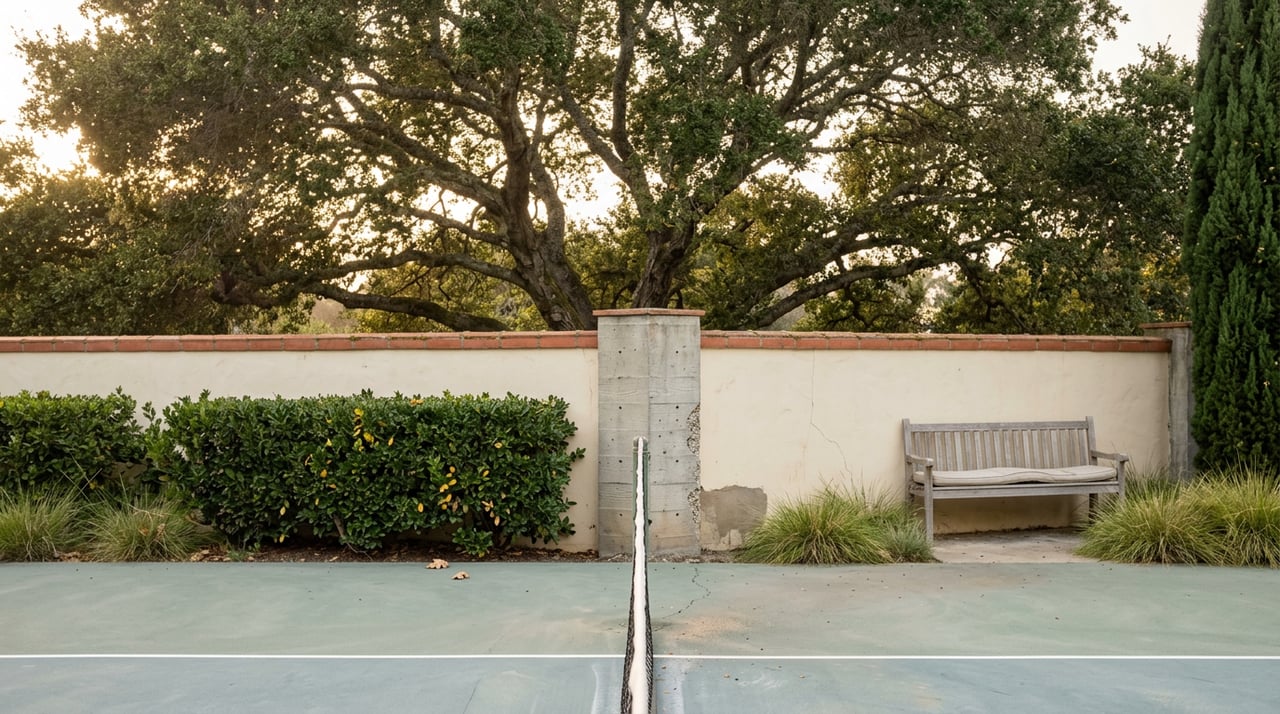
Last summer, a resident named Peter Shen set up a table tennis group behind the gates of Rolling Hills. He supplied the equipment and the space. No city budget line paid for it, no association staff ran it, and no membership drive recruited players. Neighbors just started showing up on Saturday mornings, and within a few sessions more than thirty of them had. By the second gathering in mid-August, Stroll Magazine noted that the club hosting it was "growing," which is a modest way to describe a sport that didn't exist in the community a year earlier.
That's the pattern worth understanding if you live inside these gates. Rolling Hills has no parks department, no rec center, no restaurant row where a new business opening would be the neighborhood's news of the month. It is entirely residential, with no commercial center at all. So every court, every trail, every club calendar you've ever used here exists because a resident decided to build it, decades before Peter Shen decided to build a table tennis group. The 90th year of the association that makes this possible falls in 2026, and it is worth looking at how the mechanism actually works, not just how old it is.
The Court That Started as an Argument About Rules
The tennis facility didn't begin as a club. It began as a committee. In May 1961, a group of residents formed to write down rules for the community's one and only tennis court, according to the club's own history on the RHCA site. That committee became a formal club in 1973, and it grew fast: 175 members by 1975, in a community that, per the Palos Verdes Peninsula's own community history, counted only around 690 homes total as of the early 2000s. A club with 175 dues-paying members in a city that size isn't a hobby group. It's close to a civic institution, run entirely by volunteers.
The court itself kept changing shape as the sport around it changed. In 2014, the club opened membership to every resident in Rolling Hills and became the Rolling Hills Tennis and Social Club, according to its own history on the RHCA site. Pickleball came next, and the club added four dedicated courts and picked up its current name, the Rolling Hills Courts Club, according to the club's posted rules. Table tennis is simply the newest layer on top of tennis and pickleball, not a replacement for either. The club now runs all three under one roof, and the timeline reads less like an amenity list and more like a running argument residents have been having with themselves for sixty-five years about what a shared court should be used for next.
A rough timeline, compressed:
- 1961 — Residents form a committee to govern the single community tennis court
- 1973 — The committee becomes an official club
- 1975 — Membership reaches 175
- 2014 — The club opens to all residents and becomes the Rolling Hills Tennis and Social Club
- Since then — Pickleball arrives with four dedicated courts, the club becomes the Rolling Hills Courts Club, and a resident-organized table tennis group starts up in 2025
Trails That Predate the Tennis Rules by a Decade
The bridle trail system is even older than the tennis committee, and it started the same way: residents building something because nobody else was going to. Caballeros, the community's riding club, formed in 1951 when a group of horse owners took on the job of laying out a network of trails through the hills, led by first president Jesse Powers and first trails chairman Roland Swaffield, according to the RHCA's club history. Seventy-five years later, Caballeros still maintains that network, and membership isn't limited to riders. Non-riders belong too, drawn by the same instinct that fills the tennis courts: a shared thing needs people willing to look after it.
If you've seen two different numbers thrown around for how many miles of trail actually exist here, both are probably right, they're just measuring different things. Palos Verdes Source, a community reference site with no real estate stake in the answer, puts it clearly: the city has 26 miles of private roads and 23 miles of separate equestrian trails. Conflate the two, as a lot of secondhand write-ups do, and you get a number that sounds impressive but doesn't describe anything you could actually ride.
Ninety Years, Marked With Old Photographs Instead of Fireworks
The Rolling Hills Community Association was founded in 1936 by developer A.E. Hanson, who envisioned a community of one-story ranch homes governed by deed restrictions rather than a city government, according to the City of Rolling Hills' own FAQ page. The city itself came later, incorporating in January 1957 specifically to provide services like public safety and permitting, while the RHCA kept its separate job: gates, private roads, architectural review, and the trails Caballeros started laying out six years before the city existed at all.
That split still explains why nothing here runs through a conventional parks and recreation office. The city handles code enforcement and animal control. The RHCA handles the gatehouses, the roads, and the common spaces where the clubs actually operate. Neither one runs the courts club or Caballeros directly. Both simply make room for residents to keep doing what they've been doing since 1936, which is why the association's 90th year is being marked not with a parade but with a low-key request: residents are being asked to bring their own photo albums to a scanning event, so decades of household snapshots of gates, trails, and courts can become part of a shared community archive rather than staying in someone's attic. It's a fittingly quiet way to mark nine decades of a community that has never once needed anyone outside itself to build its own recreation.
What This Looks Like If You're Reserving a Court This Week
None of this history changes how you actually book a court, but it explains why the booking process still runs through the association rather than an app built for the general public. Reservations go through the RHCA office or the yourcourts.com system, each resident can hold up to five future reservations with a two-per-week cap, and courts get cleaned on a set Thursday afternoon schedule, per the Courts Club's posted rules. Pickleball has its own open-play windows on Sundays, Tuesdays, Thursdays, and Saturday mornings, tennis keeps its own separate open-play blocks on Saturdays and Tuesday evenings, and any resident can bring up to three guests along for a match. If you want to catch whatever Peter Shen's group turns into next, that's still the system you'll be routed through, the same one 175 members were using in 1975 before pickleball or table tennis were part of the conversation at all.
That's the actual thesis worth sitting with here. This isn't a community that added amenities as it grew wealthier or more populated. It's a community where the amenities have always come first, built by whichever resident cared enough to start the committee, buy the equipment, or organize the ride, with the association simply keeping the gates and the roads clear enough for the next one to happen. Ninety years in, that habit shows no sign of slowing down.
If you're weighing a move within the Peninsula, comparing what daily life actually feels like across Rolling Hills, Rancho Palos Verdes, or Palos Verdes Estates, or you're already behind these gates and thinking through next steps for a property here, John Morgenstern knows this stretch of the South Bay in the kind of detail that doesn't show up on a listing sheet. Let's Connect.
This article is general information, not legal, tax or financial advice. Consult a qualified professional about your situation.